
March 22, 2021
IN THIS ISSUE
- Campus Compact President Andrew Seligsohn will be Guest Speaker at Barry’s Community Engagement Awards
- Barry University Continues to Address Food Insecurity in Local Communities
- Course Instructors Invited to Apply for Service-Learning Designation
Campus Compact President Andrew Seligsohn Will Be Guest Speaker At Barry’s Community Engagement Awards
University Leaders To Participate In Virtual Event On April 7


Dr. Seligsohn is the leader of a national coalition of colleges and universities dedicated to the public purposes of higher education. Awards will be presented in various categories of community engagement. President Mike Allen and Provost John Murray will participate in the live-streamed event.
Dr. Andrew Seligsohn, president of Campus Compact, will be the guest speaker at Barry University’s eighth annual Community Engagement Awards on April 7.
Seligsohn is the leader of a national coalition of colleges and universities dedicated to the public purposes of higher education. He previously served as associate chancellor for civic engagement and strategic planning at Rutgers University–Camden and director of civic engagement learning at Princeton.
Barry University’s president, Dr. Mike Allen, is a member of Campus Compact. The university has participated in the organization’s work for several years and takes the opportunity, through the Newman Civic Fellows program, to bring national recognition to a Barry student’s civic engagement each year.
In late 2015, then Barry president, Sister Linda Bevilacqua, O.P., Ph.D., was one of the early signers of Campus Compact’s Thirtieth Anniversary Action Statement of Presidents and Chancellors. To meet an institutional commitment, the university subsequently developed a Civic Action Plan and submitted it to Campus Compact. The organization then recognized Barry as a “Campus in Action.”
Among university leaders slated to participate in the Community Engagement Awards Ceremony are President Allen, who will deliver remarks, and Dr. John D. Murray, provost, who will present the Engaged Department Award.
The Center for Community Service Initiatives (CCSI) will host the 90-minute virtual/live-streamed ceremony, which is scheduled to begin at noon. Awards will be presented to students, faculty and staff members, and a community partner for their participation, contributions, and achievements in various categories of community engagement.
Barry University Continues To Address Food Insecurity In Local Communities
How Does Our Garden Grow?
Food insecurity is a long-standing problem in Miami-Dade neighborhoods. The problem has become more prevalent since the onset of the 2019 coronavirus disease (COVID-19).
Through the work of its Center for Community Service Initiatives (CCSI), Barry University is keeping food insecurity high on its community engagement agenda. The CCSI has developed a service-learning module focused on food security to facilitate student responses to the problem.
The food security module is designed to engage students in supporting local, national, and international efforts to address food insecurity and end hunger. Specifically, students may assist in maintaining urban gardens, or small food farms, and may sort and pack food supplies for distribution to households in need.
“Food insecurity is more than a lack of food; it is a lack of nutrition, access, support, and resources,” explains Kaitlyn Gallagher, a CCSI-based AmeriCorps VISTA (Volunteers in Service to America) member. “Addressing food insecurity does not exist in isolation, as many of the causes of food insecurity stem from a variety of other social justice issues such as poverty.”


On Barry’s Miami Shores campus, an urban garden came to fruition in 2018. Known as the BUG, the Barry Urban Garden grew out of the Barry FairShare project and now encompasses it.
Described as “a values-based community agriculture initiative,” the BUG has been created to provide produce to low-income residents in nearby neighborhoods categorized by the U.S. Department of Agriculture as “urban food deserts.” Liberty City and Little Haiti are two such neighborhoods in Miami-Dade County.
The garden itself is occupying small spaces adjacent to Powers Hall—on the southwestern side of the building, which is home to the Adrian Dominican School of Education.
The BUG concept is rooted in permaculture design principles. Permaculture is approached as both a philosophy and a strategy branded as “Earth Care, People Care, Fair Share.”
Springing up in the garden this growing season are root vegetables such as carrots and sweet potatoes; leafy greens like curly and dino kale, butterhead and radicchio lettuce, and collard greens as well as broccoli, string beans, celery, and arugula—plus parsley and other herbs.
There you’ll find some sugarcane; three kinds of tomatoes—cherry, lucid gem and San Marzano; cucumbers; and other fruits such as strawberry, dragon fruit, papaya, and banana.
Gallagher, the AmeriCorps volunteer, serves as coordinator of the BUG. She supervises students and staff members as they lend a hand with various gardening tasks.
Barry Service Corps (BSC) Fellows Luca McLeod, Javier Bracho, and Dai’ Jonnai Smith have consistently assisted with garden maintenance this academic year. Doreen Noel, a BSC member, is among other students assisting this year.
“Many in the wake of COVID-19 are experiencing food insecurity for the first time, and it is important that communities continue to address the issue, whether it be through advocacy, food banks, community fridges, or community gardens,” Gallagher says. “Education and awareness are fundamental when addressing food insecurity. … When speaking about food insecurity to students, I try to highlight that there is no one way that food insecurity is experienced.”
Service-Learning Project Site
The BUG is a site for service-learning projects. A small team of Barry math students, for example, used the garden as an experiential learning site for their service-learning project benefiting middle-school children in Miami’s Gang Alternative program. The Gang Alternative group was challenged to solve “a real-life problem” pertaining to an irregularly shaped area that the garden occupies.
Meanwhile, students in Barry’s undergraduate nursing program did some research regarding the medicinal properties and benefits of plants. They surveyed local community residents to find out the medicinal plants the residents knew from their native countries and would like to see in the BUG.
Now, the BUG planners say a garden plot will remain reserved for medicinal plants. Aloe vera is expected to take root there. So, too, calendula, chanca piedra, comfrey, and vervain.
People use aloe vera gel as a salve for burns and skin ailments; calendula has been used for treating various conditions—from diaper rash and sore throat to jaundice and hemorrhoids. Some householders swear by comfrey; they use it as a tea for upset stomach, ulcers, heavy menstrual periods, diarrhea, and the like. Chanca piedra and vervain are considered good medicinal plants as well.
The BUG is a site for service-learning projects. … The CCSI developed Barry FairShare—now a component of the BUG—in partnership with Urban GreenWorks.
Text by
Glenn Bowen

Photos by
Kaitlyn Gallagher
The CCSI launched Barry FairShare in January 2017 as a project to advance community-supported agriculture. The project was aimed at providing produce to campus and earnings to small farmers while improving food security in neighborhoods near campus.
The CCSI developed the project in partnership with Urban GreenWorks, a local environmental and food-access organization, whose Cerasee Farm is in Liberty City.
Barry faculty, staff, and students have participated in Barry FairShare by purchasing produce harvested from Cerasee and other sustainable small farms.
In 2019, before COVID-19, Barry FairShare operated a farmers stand on campus. Displayed for sale were fruits and vegetables cultivated and harvested by local-area small farmers who practice sustainable agriculture.


Many in the wake of COVID-19 are experiencing food insecurity for the first time, and it is important that communities continue to address the issue, whether it be through advocacy, food banks, community fridges, or community gardens.


Course Instructors Invited to Apply for Service-Learning Designation
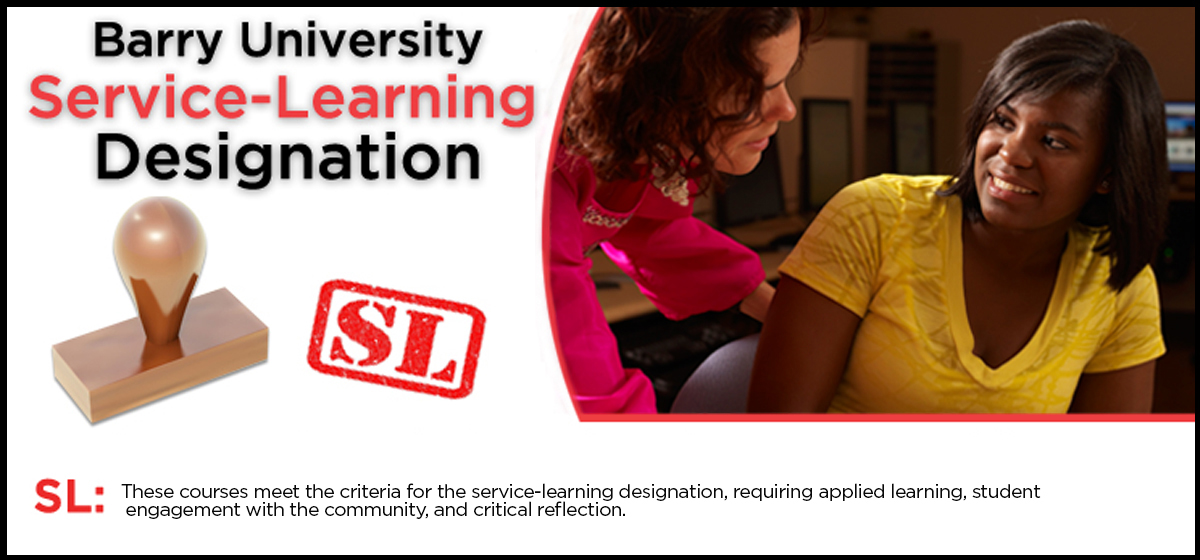
Courses that meet specific criteria are labeled “service-learning” in the course schedule and are listed as such in the university catalogs.
The Center for Community Service Initiatives (CCSI) is inviting faculty members whose courses include a service-learning component to apply for the service-learning designation.
Sections of courses, internships, practicum assignments, field education, capstones, community-based research, and similar community-focused or community-based work also may be designated as service-learning.
“Designating courses as service-learning promotes deep integration of thoughtfully organized community service into the curriculum and high standards of service-learning practice,” according to a statement from the CCSI. “Service-learning courses demonstrate the value of applied learning, student engagement with the community, and critical reflection.”
The Service-Learning Designation Committee uses specific criteria to review applications. Courses that meet all criteria are labeled “service-learning” in the course schedule and are listed as such in the university catalogs.
Additional information on the service-learning designation is available at the CCSI website.


Contact Brittney Morales, Barry Service Corps program facilitator, at BriMorales@barry.edu.
COMMUNITY ENGAGEMENT SYMPOSIUM: Registration for Barry’s seventh annual Community Engagement Symposium continues. Students, faculty, and staff are asked to register for the virtual/online event, which will be held next Wednesday, March 31, from 9 a.m. to 3 p.m.
COMMUNITY ENGAGEMENT AWARDS: The CCSI has extended an open invitation to Barry’s eighth annual Community Engagement Awards. Students, faculty, and staff are asked to “RSVP” for the virtual/online event, which will be held on Wednesday, April 7, from noon to 1:30 p.m.
NEHEMIAH ACTION: Miami-Dade’s PACT (People Acting for Community Together) staged its Nehemiah Action recently in North Miami. Barry was well represented at the drive-in event. Read all about it in the next issue of Community Engagement News.
Apply to become a mentor (aka Big): https://bbbsmiami.org/volunteer/apply/

11300 NE 2nd Avenue
Adrian 208
Miami Shores, FL 33161